
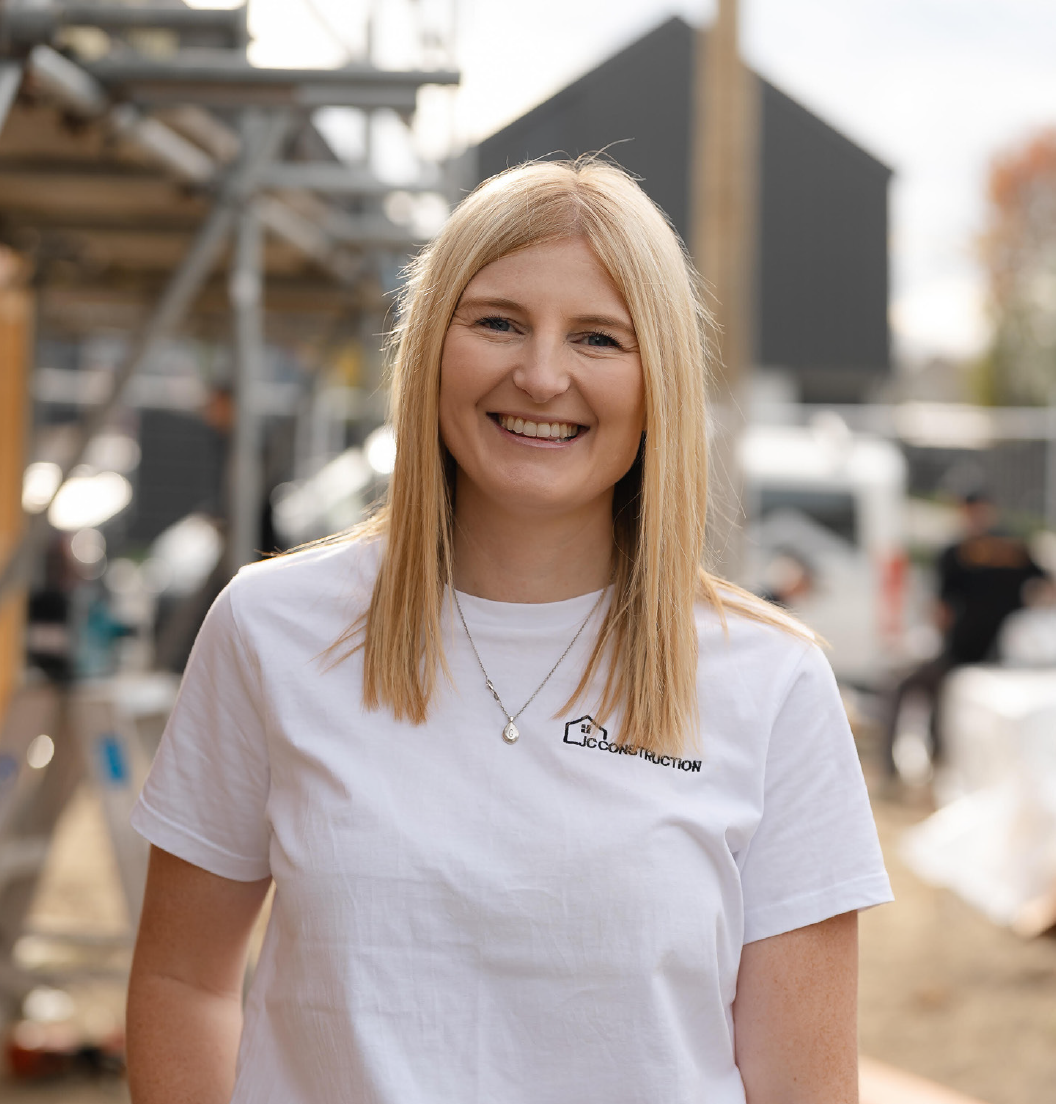
JC Construction co-owner Pagan Crane explains how The Professional Builder helped the company get to where it is today.
I think you learn pretty quickly that you don’t need to know how to swing a hammer better than everyone else to add value to a construction business, JC Construction co-owner Pagan Crane says.
It’s a statement that sums up everything about how she came to run one of Canterbury’s growing residential construction companies.
“In the early days, there were definitely situations where people assumed my husband Jason was the person they needed to speak to, even when the question was actually about something I managed,” she says.
“Seeing the business grow and realising that some of the things I brought from completely different industries actually worked incredibly well in construction was probably when I started feeling like I belonged.”
Pagan’s background couldn’t be further from a building site. Before JC Construction, she spent years working across fashion, e-commerce, operations and marketing — industries that demand sharp systems thinking and a close eye on the numbers.
When she stepped into the business alongside Jason, she brought that same lens with her, applying it to a trade that, on the surface, seemed worlds apart from anything she’d done before.
Jason, meanwhile, had been in construction his entire working life, starting at his uncle’s timber mill during school holidays, moving straight into his building apprenticeship, and working his way through leading-hand, foreman and site management roles.
Initially when the pair started JC Construction together in 2021, Jason was very much running the construction side while Pagan was still working in her own career and helping behind the scenes.
As the business grew, so did her involvement, until eventually it became something they were genuinely running together. Their different backgrounds were less a mismatch than a genuine advantage.
“Jason understands building inside out,” Pagan says. “And I came into it looking at the business, systems, people, marketing and customer experience from a completely different perspective.”
The pressures of a fast-growing business
JC Construction found early momentum. Word spread quickly through Canterbury about the quality of their work, and the projects kept coming. But rapid growth brings its own pressures, and the couple soon found themselves navigating questions that don’t have easy answers.
“Are we making the right decisions? Are we growing at the right pace? Are our margins where they should be? Do we have enough work ahead of us without overcommitting? When you’re right in the middle of it every day, it can be hard to stand back and objectively look at the bigger picture.”
It wasn’t that anything was broken. They’d both arrived with strong experience in their respective areas, and had already put serious thought into their systems, numbers and direction. But they wanted someone who could look at what they were already doing, challenge their thinking, and give them additional tools.
“We didn’t want to wait until something was wrong before seeking advice. There is a lot of value in having someone outside your business look in. Sometimes they confirm that what you’re doing is right, and other times they make you look at something you’ve been doing for years in a completely different way.”
Finding structure through TPB
That outside perspective came through The Professional Builder, a coaching organisation founded in Auckland in 2004 by Marti Amos, which works exclusively with residential building company owners across New Zealand and internationally. Pagan and Jason joined its Leaders in Construction programme, and it’s become a defining part of how they run JC Construction today.
The coaching didn’t reinvent the business from scratch. Instead, it sharpened what was already there — giving reassurance in the areas where their instincts had been right all along, and new tools and fresh ways of looking at problems where they’d been stuck. It made them more deliberate about their numbers, margins, overheads, forecasting, capacity, and the type of work they actually wanted to take on.
“One thing we’ve learnt is that there isn’t really a point where you suddenly have business completely figured out,” Pagan says. “Our goals are constantly changing. We reach one milestone, learn something new and then set another target. JC today isn’t the finished product, and I don’t think it ever will be.”
A clearer sense of direction
The results are visible. JC Construction has grown into a team of around 20, supported by a much stronger leadership structure than the couple started with. Systems around forecasting, programming, pricing, and project management that were once a source of uncertainty are now well established, and the scope of their work has expanded considerably.
What began as a Canterbury residential outfit now spans architectural builds, multi-unit developments, renovations, and light commercial projects, reaching further across the South Island.
Perhaps most tellingly, how Pagan and Jason think about growth has shifted. Rather than chasing turnover or headcount for its own sake, they’re far more deliberate about what they say yes to.
“We’ve learnt that growth isn’t just about adding more staff, taking on more projects, or increasing turnover. It has to be the right growth for the business and the team.”
For any builder reading this who recognises the feeling — booked out, working hard, and still wondering where the money goes at the end of the year — Pagan’s advice is direct.
“Don’t think that asking for outside advice means you don’t know how to run your business. Sometimes you actually need someone to tell you that you’re doing a lot of things right. But, equally, you need to be open enough to have somebody challenge you, give you another way of looking at something, or introduce you to tools and resources you haven’t come across before.”
Beyond that, she keeps it practical.
“Know your numbers, understand your margins and overheads, know where your work is coming from, and have a clear idea of what you’re trying to build. And accept that the goalposts will move. What success looked like to us three years ago isn’t necessarily what success looks like to us today — and I’m sure it will look completely different again three years from now.”